Size guide · July 31, 2026
How to Choose the Right Caftan Size Online: Complete Guide
Learn how to measure for a Moroccan caftan, use the size chart and choose a comfortable, elegant fit when shopping online.
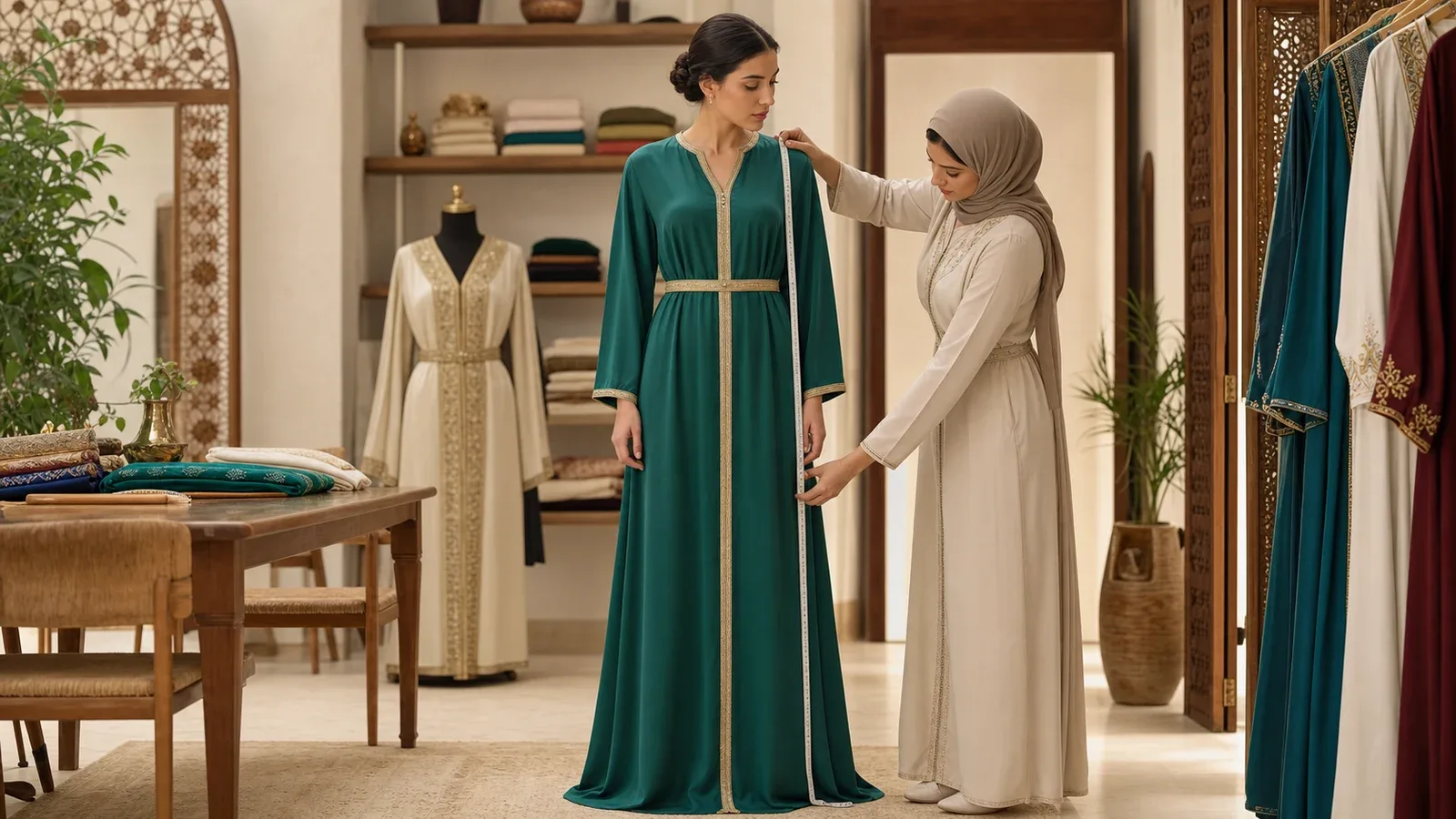
Shopping for a caftan online gives you access to many cuts, colors and finishes, but it also raises one important question: how do you choose the right Moroccan caftan size without trying it on first?
A women’s caftan should look elegant, feel comfortable and suit your shape. It should not pull across the bust or hips, but it should not be so large that its structure disappears. Length matters too, especially when you plan to wear heels.
This guide explains how to take accurate measurements, read a size chart and choose a Moroccan caftan that fits naturally.
Quick advice: use your current body measurements, not the clothing size you usually buy.
Why caftan fit matters
The Moroccan caftan combines elegance, comfort and skilled craftsmanship. Depending on the design, its cut may be straight, shaped, flowing, loose or closely fitted.
The right size allows the caftan to:
- fall naturally over the body;
- remain comfortable for several hours;
- keep the embroidery, sfifa and front closure aligned;
- avoid pulling or excess folds across the bust;
- work with the shoes you plan to wear;
- let you walk and sit easily.
A caftan that is too small may pull at the shoulders, upper arms, bust or hips. A caftan that is too large may lose its shape, feel heavy and require extensive alterations.
Measurements to take before ordering
You will usually need five measurements when ordering a Moroccan caftan online:
- bust circumference;
- natural waist circumference;
- hip circumference;
- shoulder-to-floor length;
- sleeve length.
Use a flexible dressmaker’s tape and wear light clothing. Keep the tape close to the body without pulling it tight.
1. Measure your bust
Wrap the tape around the fullest part of your bust and check that it stays level across your back.
Breathe normally and do not tighten the tape. Only add ease if the store’s size instructions explicitly ask you to do so.
The bust is especially important for a shaped caftan or any design with a structured upper body.
2. Measure your natural waist
Measure around your natural waist, usually a little above your navel. To find it, bend gently to one side; the crease that forms indicates your natural waist.
This measurement matters when the caftan is worn with a belt or mdamma.
3. Measure your hips
Wrap the tape around the fullest part of your hips and seat. Keep your feet close together and the tape level.
A straight or lightly shaped caftan needs enough room here for comfortable steps and sitting.
4. Measure the caftan length
Caftan length is normally measured from the highest point of the shoulder to the floor.
For an accurate result:
- stand upright and look ahead;
- wear the shoes intended for the outfit;
- let your arms rest naturally;
- ask another person to take the measurement.
If you will wear heels, measure while wearing those heels. With flat shoes, avoid an overly long hem that drags or becomes easy to step on.
5. Measure the sleeve length
Measure from the shoulder point to the wrist with your arm slightly bent.
Some modern Moroccan caftans have long, flared or heavily decorated sleeves, so compare this measurement with the product details.
Caftans Yasmine size chart
Use this chart as a starting point and check the specific product description before ordering.
| Size | Bust | Waist | Hips | |---|---:|---:|---:| | XS | 82–86 cm | 64–68 cm | 88–92 cm | | S | 86–90 cm | 68–72 cm | 92–96 cm | | M | 90–96 cm | 72–78 cm | 96–102 cm | | L | 96–102 cm | 78–84 cm | 102–108 cm | | XL | 102–110 cm | 84–92 cm | 108–116 cm | | XXL | 110–118 cm | 92–100 cm | 116–124 cm |
Fit can vary with the cut, fabric and construction. Always check the measurements and notes shown for the individual caftan.
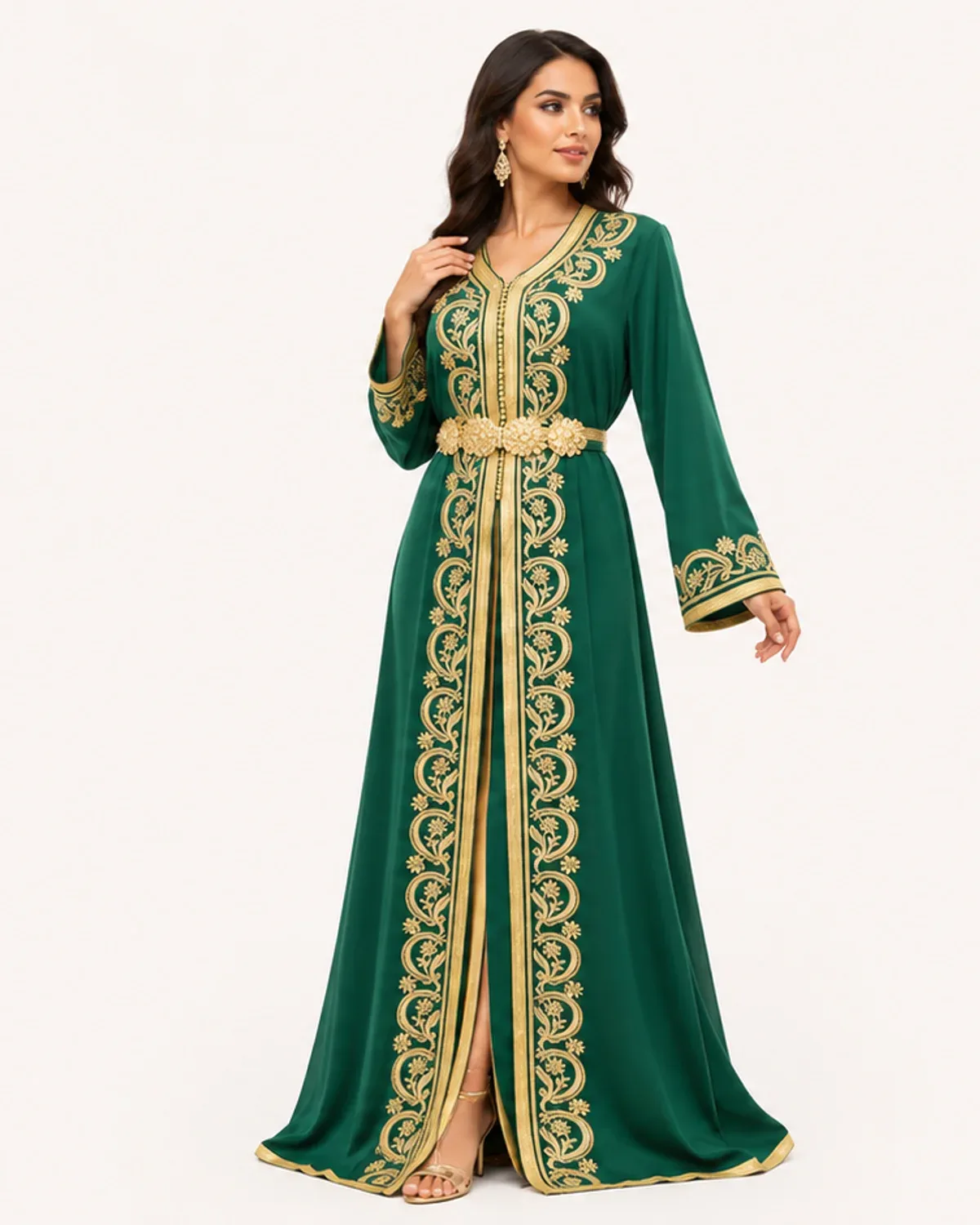
Should you order your usual clothing size?
Not always. One brand’s M can fit like another brand’s L, and a traditional Moroccan caftan does not necessarily follow the cut of a dress, abaya or takchita.
To choose your caftan size:
- take your current body measurements;
- compare each one with the product chart;
- note the size indicated by your bust, waist and hips;
- choose the largest of those three sizes;
- check the cut and any information about stretch.
For example, if your bust indicates M but your hips indicate L, choose L in most cases. This means choosing the larger garment size produced by your measurements, not simply the measurement with the highest number. A slightly loose caftan is usually easier to alter than one that is already too tight.
What if you are between two sizes?
Use the caftan’s cut and fabric to decide.
Fitted caftan
Choose the larger size. A shaped caftan should follow your figure without putting strain on the seams or embroidery.
Flowing caftan
The smaller size may work when the garment is intentionally generous, but confirm the bust, upper arms and hips first.
Belted caftan
A belt can define the waist. Prioritize the shoulders, bust and hips, then use the belt to refine the silhouette.
Heavily embroidered or non-stretch caftan
Choose the larger size. Dense embroidery, brocade and some traditional fabrics provide less flexibility.
How to choose the right caftan length
The ideal length depends on your height, shoes and the occasion.
With flat shoes
The hem can sit close to the floor, but it should not be long enough to step on while walking.
With heels
Take the shoulder-to-floor measurement while wearing the intended heels; their height is then already included. Do not add it a second time. For a wedding or formal occasion, a long caftan may lightly skim the floor.
For a petite wearer
Too much width or length can overwhelm the frame. A correctly shortened hem and vertical embroidery help preserve the caftan’s proportions.
For a tall wearer
Check the total length and sleeve length carefully. Standard-length garments may finish higher than expected.
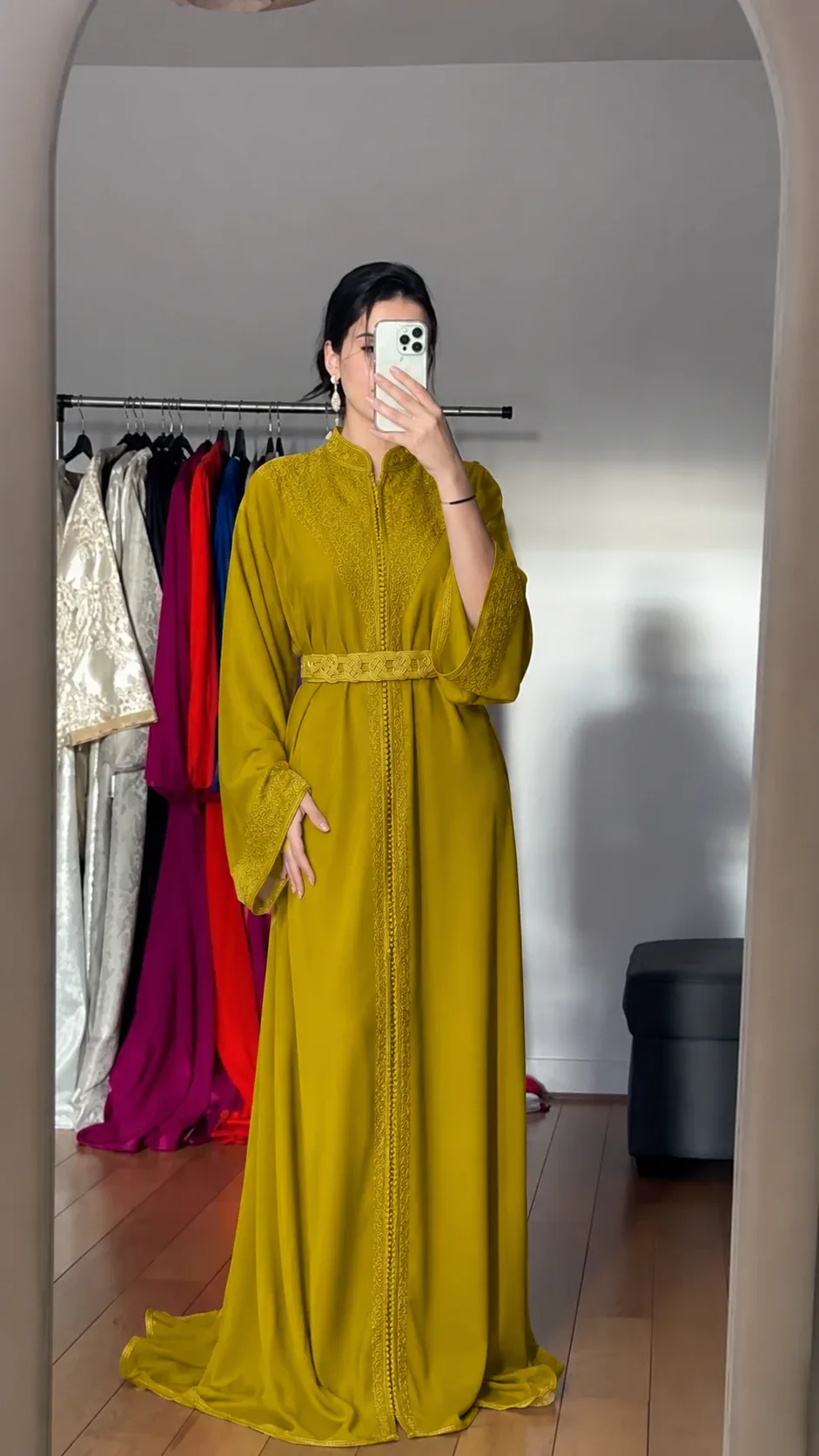
Choose the size for the caftan’s cut
Straight caftan
A straight caftan is elegant and comfortable, but it still needs enough room through the hips.
Fitted caftan
A fitted caftan defines the waist more closely, so bust, waist and hip measurements all need to match the chart.
Loose caftan
A loose caftan offers easy movement, but the shoulders, sleeve length and overall length must still fit.
Belted caftan
The belt gives some flexibility at the waist. It cannot correct a garment that is too tight across the bust or hips.
Two-piece caftan or takchita
Check the measurements of both the inner and outer pieces. Layering can require additional ease. Our caftan versus takchita guide explains the difference in construction and volume.
Fit and body shape
Your measurements determine the size; body-shape advice should only help you choose the cut.
- Fuller hips: choose a cut that fits the hips without pulling and lets the upper detail draw the eye upward.
- Broader shoulders: look for fluid sleeves and avoid an upper body that is already too structured.
- Straighter shape: a belt can add definition without requiring a smaller garment.
- Defined waist: a fitted cut or mdamma can emphasize the natural waist.
- Fuller figure: prioritize comfortable shoulders and a smooth, lightly flowing fit rather than sizing down.
What to check on a product page
Before ordering, review:
- front, back and side photographs;
- the description of the cut;
- the model’s measurements and the size shown;
- fabric composition and lining;
- whether the fabric stretches;
- total garment and sleeve lengths;
- exchange conditions.
Browse our women’s Moroccan caftans and compare your figures with the Caftans Yasmine size guide. The guide to choosing a Moroccan caftan can also help match the cut to the occasion.
Common sizing mistakes
Choosing by weight alone
Two people of the same weight can have very different proportions. Use bust, waist and hip measurements instead.
Sizing down for a fitted effect
A smaller caftan does not automatically look more elegant. It may pull at the seams and distort the embroidery.
Forgetting the shoes
Heel height directly affects where the hem falls.
Measuring over thick clothing
Measure over light clothing or close to the body so that you do not add unnecessary centimeters.
Using a rigid tape
Use a flexible dressmaker’s tape, not a construction tape measure.
Ignoring the fabric
Crepe, satin, velvet and brocade drape differently. A fabric with little stretch needs more ease.
Can a caftan be altered?
Yes. An experienced dressmaker can often adjust:
- the hem;
- sleeve length;
- side seams;
- waist width;
- belt position;
- selected decorative elements.
It is generally safer to alter a slightly large garment than to let out a caftan that is too small, particularly when embroidery or beadwork crosses the seams.
How to check the fit when it arrives
- Wear the undergarments intended for the outfit.
- Put on the shoes you plan to wear.
- Fasten the aakad buttons correctly.
- Position the belt at a comfortable height.
- Raise your arms and walk a few steps.
- Sit down to check the waist, hips and knees.
- Look at the front and back hem in a mirror.
The caftan should remain comfortable across the shoulders, bust, arms and hips.
Buy a Moroccan caftan online with confidence
Remember three rules:
- take accurate measurements with a flexible tape;
- compare them with the chart for that design;
- choose the largest garment size indicated by your bust, waist or hips, then consider the cut.
A well-fitted Moroccan caftan lets the fabric, embroidery and artisan finish sit as intended while allowing you to enjoy the event comfortably.
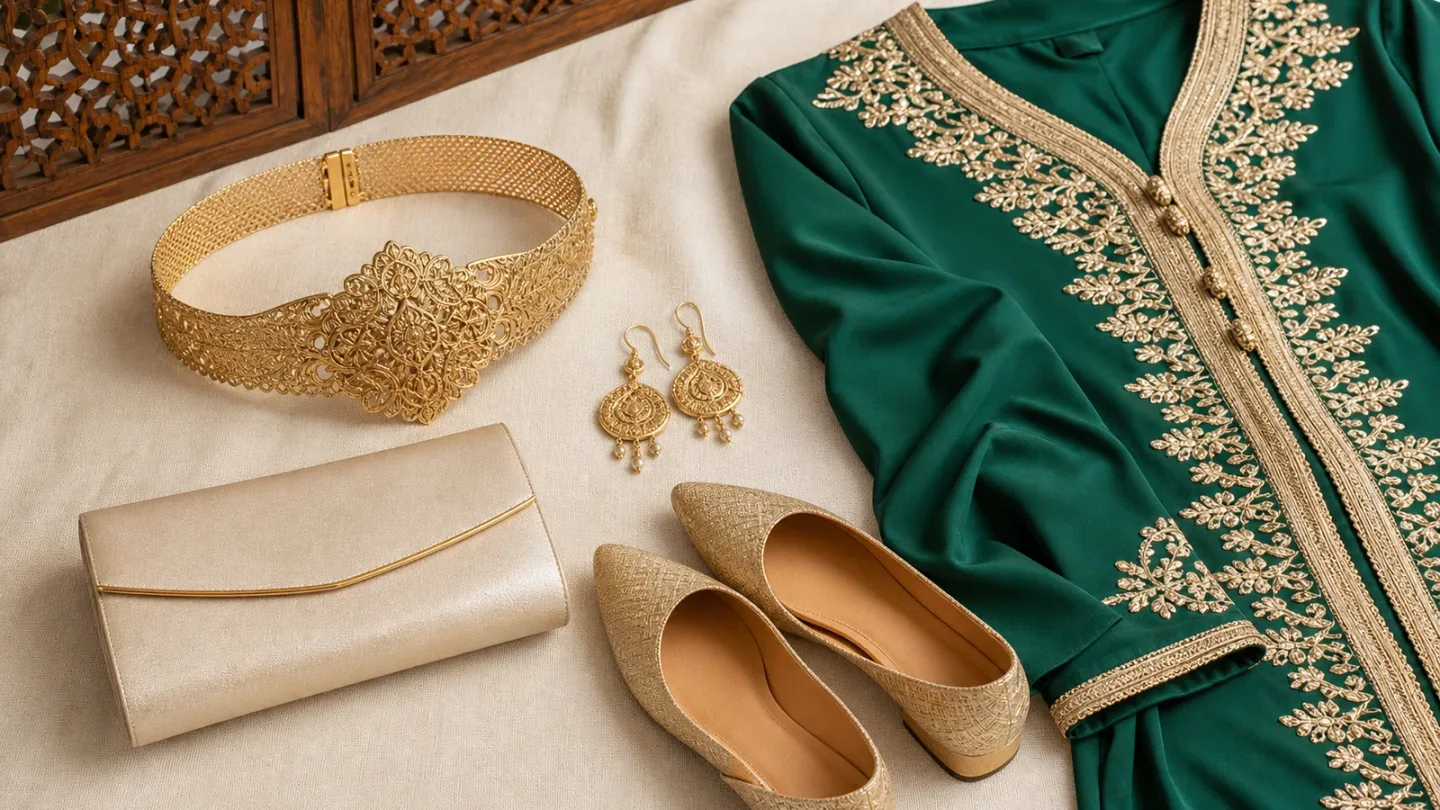
Explore Caftans Yasmine women’s caftans. Once you have chosen the fit, use our caftan accessories guide to balance the belt, jewellery and shoes.
Frequently asked questions
How do I know which caftan size to choose?
Measure your bust, waist and hips, compare each figure with the chart, then choose the largest garment size indicated by those three measurements.
Should a caftan fit tightly?
No. It should follow the silhouette without limiting movement or pulling across the bust, arms or hips.
Should I size up?
Size up when you are between sizes, when the fabric has little stretch or when the caftan has a closely fitted cut.
How do I measure caftan length?
Measure from the highest shoulder point to the floor while wearing the intended shoes.
What size should I choose for a belted caftan?
Choose according to the shoulders, bust and hips. Use the belt to adjust the waist rather than sizing down.
Can a long caftan be shortened?
Usually, yes. Ask an experienced dressmaker to preserve any embroidery and finish around the hem.
Is a caftan size the same as a dress size?
Not necessarily. Use the measurements shown for the caftan rather than relying only on your usual dress label.
Between two sizes? Review our size guide or contact Caftans Yasmine before ordering.